· Kai · 7 min read · Technicals

The answer has four parts. The income statement measures profit over a period and ends at net income. The balance sheet shows what the company owns and owes on one date. The cash flow statement starts from net income, adjusts it back to cash and ends at the change in cash for the period. The fourth part earns the marks: net income flows into retained earnings and opens the cash flow statement, and the change in cash lands on the balance sheet. Say it in that order, in about ninety seconds, with most of the time on the links.
This is question four on the mock-interview ladder I run on assessment calls, one step before the follow-up about $10 of depreciation. The ladder climbs from where a candidate is strongest until something gives, and the candidate who gives way here has a familiar profile: the definitions correct, the terms in place, and no sentence connecting one statement to the next. They learned the three statements as three topics. The interviewer tests them as one.
What each statement measures
The SEC's guide for new investors makes the point your interviewer is testing: "No one financial statement tells the complete story." Each statement answers a different question and hands a number to the next.
| Statement | What it shows | The line that links onward |
|---|---|---|
| Income statement | Revenue earned and expenses incurred over a period | Net income |
| Balance sheet | Assets, liabilities and shareholders' equity at one date | Cash, and retained earnings inside equity |
| Cash flow statement | Cash in and cash out over the same period, in three sections | Net change in cash |
The balance sheet is the odd one out: a snapshot at the period's end, where the other two cover the period, and the cash flow statement explains how cash moved from one balance sheet to the next.
The three links interviewers listen for
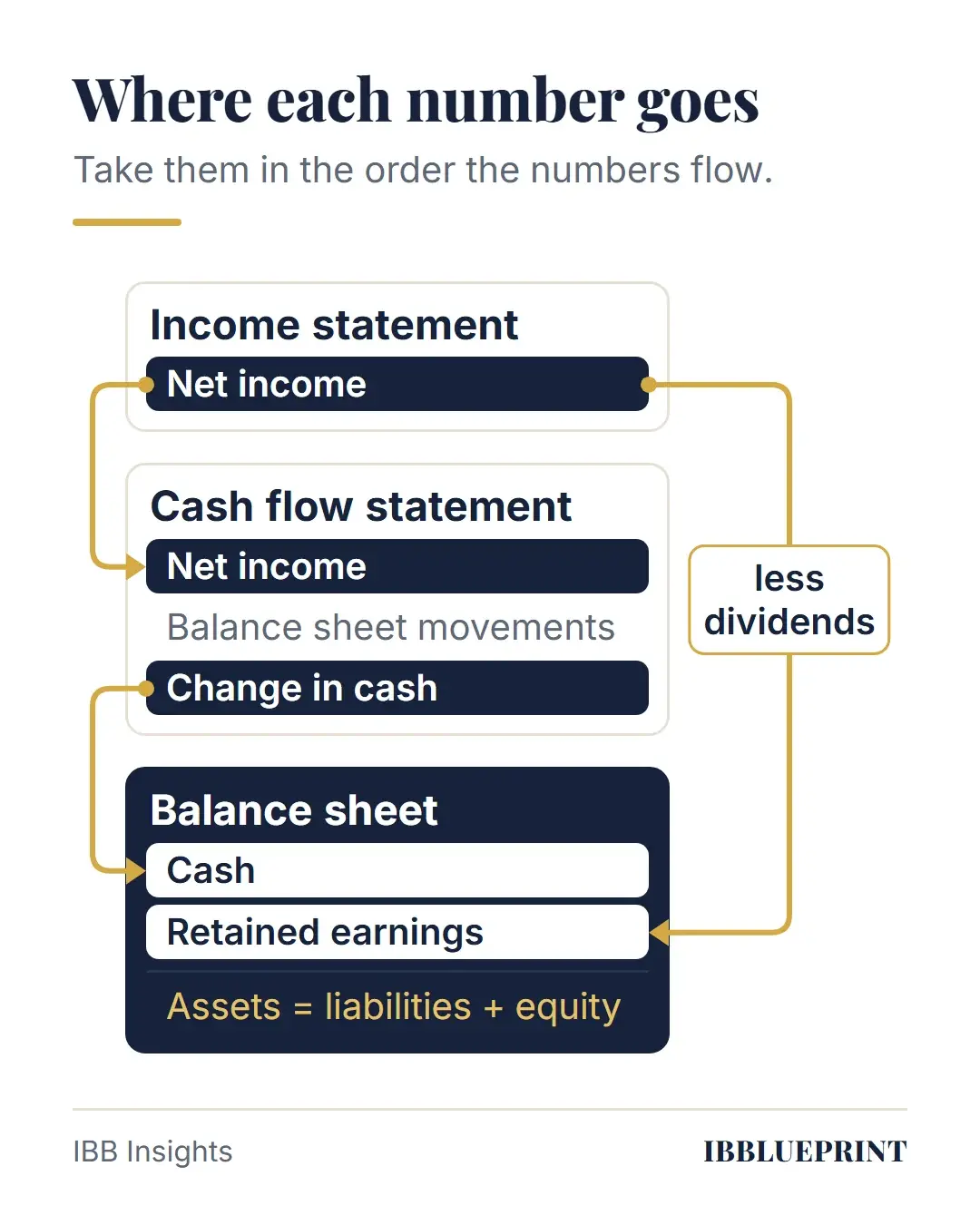
Net income opens the cash flow statement. In the indirect method, the format interviews assume, the operating section starts with net income and adjusts it. IAS 7 describes the method as one where "profit or loss is adjusted for the effects of transactions of a non-cash nature"; depreciation is the classic add-back. The same net income, less any dividends, moves retained earnings on the balance sheet.
Balance sheet changes fill the cash flow statement. A rise in receivables or inventory uses cash and sits in operating activities. Buying equipment sits in investing. Borrowing, repaying, issuing shares and paying dividends sit in financing. IAS 7 sorts each cash flow into one of those three sections, so the middle of the cash flow statement is a list of balance sheet movements translated into cash.
The change in cash lands on the balance sheet. The bottom line of the cash flow statement is the difference between the cash line on the opening balance sheet and the cash line on the closing one. Every other change has already passed through the income statement or the cash flow statement, which is why the closing balance sheet balances.
A 90-second model answer
"There are three statements, and I'd take them in the order the numbers flow: income statement, cash flow statement, balance sheet. The income statement covers a period and runs from revenue, through operating costs, interest and tax, down to net income."
"The cash flow statement starts from that net income and works back to cash. It adds back non-cash charges such as depreciation, adjusts for changes in working capital, then shows cash spent on investments and cash raised from or returned to lenders and shareholders. Its bottom line is the change in cash for the period."
"The balance sheet is the snapshot at the period's end. The change in cash moves the cash line, net income less dividends moves retained earnings, and the working capital, capex and financing items each move their own line. Because every change has passed through one of the other two statements, assets still equal liabilities plus equity."
One paragraph per statement, with the links inside rather than bolted on at the end. Then stop and let the interviewer pick the follow-up.
Why cash from operations is not net income
The follow-up that separates candidates: "so why isn't cash from operations just net income?" The textbook answer is non-cash charges and working capital, and a real cash flow statement shows how large both can be.
$112.0bn
Net income
+$11.7bn
Depreciation and amortisation added back
+$12.9bn
Share-based compensation added back
$111.5bn
Cash generated by operating activities
Source: Apple's Form 10-K for the year ended 27 September 2025, consolidated statement of cash flows, in millions of dollars.
Apple added back $24.6bn of non-cash charges and still finished with cash from operations $0.5bn below net income. Receivables grew by $6.7bn, revenue booked and not yet collected, and other liabilities fell by $11.1bn, cash paid against obligations booked earlier. The year before, the same statement ran the other way: cash from operations of $118.3bn against net income of $93.7bn. The gap is working capital, and the SEC guide's phrasing is the one to borrow: cash flows are related, but not equivalent, to net income.
The two follow-ups to expect
"Depreciation goes up by $10. Walk me through the statements." This is the classic follow-up. Knowing the Answer Is Not the Same as Passing walks it statement by statement at a 25% tax rate and explains why the balance sheet still balances.
"Which statement does a DCF start from?" None of them directly. Unlevered free cash flow is built from EBIT on the income statement, taxed as if the company carried no debt, then adjusted for depreciation, capex and working capital from the other two. What Is NOPAT? covers the tax step and Walk Me Through a DCF covers the rest.
How to practise it this week
- Say it aloud against a clock. Ninety seconds, no notes, three times in a row. If the third attempt is not shorter than the first, you are still reciting.
- Find net income three times in a real 10-K. Pull the annual report of a company you follow and locate net income at the bottom of the income statement, at the top of the cash flow statement and inside the retained earnings movement. Textbook statements are tidied up; real ones are not, and interviewers describe the real ones.
- Drill the follow-ups in order. The $10 of depreciation first, then the DCF link. Each tests the same three links from a different angle.
The rest of the technical interview builds on these three links. More free material is in the Knowledge Base, and new pieces land in IBB Insights.
Reading about it is step one.
Practice is step two — members drill these questions in the Superday Dojo, graded on whether they understood the concept. The Knowledge Base has more to read in the meantime.